On the resolution of dual readout calorimeters

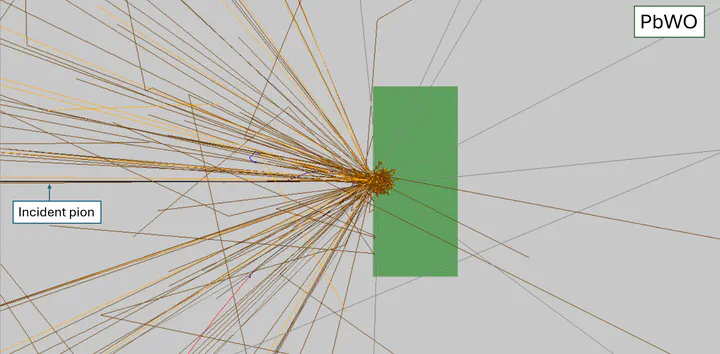 Shower from a 20 GeV charged pion for crystal calorimeter PbWO
Abstract
Dual readout calorimeters allow state-of-the-art resolutions for hadronic energy measurements. Their various incarnations are leading candidates for the calorimeter systems for future colliders. In this paper, we present a simple formula for the resolution of a dual readout calorimeter, which we verify with a toy simulation and with full simulation results. This formula can help those new to dual readout calorimetry understand its strengths and limitations. The paper also highlights that the dual readout correction works not just to compensate for binding energy loss, but also for energies escaping the calorimeter or clustering algorithm. Formulae are also presented for approximate resolutions and energy scales in terms of different sources of response.
Type
Publication
Nuclear Instruments and Methods in Physics Research Section A: Accelerators, Spectrometers, Detectors and Associated Equipment
We have presented a simple formula that predicts the improvement (or lack thereof) when utilizing the dual readout energy estimate for a calorimeter. The formula works for a wide variety of calorimeters, including both calorimeters whose response variation is dominated by losses to overcoming nuclear binding energy and those dominated by fluctuations in energy escaping the calorimeter.